

Living a 12-day Birding Tour through the Yucatan Peninsula


After 12 days of birdwatching, hundreds of kilometers covered, and many species checked off, one might think it would be hard to pick a favorite moment. However, by the end of the tour, everyone agreed. The best day was the one that had it all: incredible birds, surprises, culture, learning, and a good dose of excitement.
We know that some bird species are harder to spot than others due to their habits, limited range, or because they are endangered. That is why we like to make a solid effort to locate as many birds as possible, right from day one of our itineraries.
This time was no exception. By spending more than two nights in highly diverse areas, such as Río Lagartos or the Calakmul region, we expanded our chances of finding each location's specialties.
Earlier this year, we set out on a 12-day birding tour through the Yucatán Peninsula, covering all the habitats across the three states that make up the peninsula. Our companions for this tour found us through both companies: Birding Mexico Expeditions and Birding in the Yucatan Peninsula. We stayed in constant communication for months, ensuring all details were clear for both them and us, guaranteeing a safe trip that met everyone's expectations. Two of them, Joan and Dave, joined the tour for the first few days; they were already traveling with us, as we had just come from birding in Calakmul.

.Through this link, you can review the trip report for this journey on eBird, including the route, the observation sites, and the impressive bird list we managed to record along the way.
Below, I will share a day-by-day account of how this 12-day birding tour unfolded.
Day 1: January 8, 2026
Since all the participants decided to arrive a couple of days before the birding tour started to spend some time on their own enjoying the beach in Cancún or the Mayan jungle of Puerto Morelos, the first day on the itinerary turned into the very first birding session of the trip. Originally, day 1 of this itinerary is meant for the pick-up and, if time permits, an afternoon or evening birding outing.

So, we decided to visit the Uxuxubi reserve. It isn't part of the original itinerary proposal, but it is always a great choice because it's such a special place. It is a very well-preserved reserve near Akumal, where local members have worked hard to put it on the map as one of the country's top birding spots, with numerous recorded species.
We started finding the most abundant birds, such as the Cinnamon Hummingbird, the Golden-fronted Woodpecker (the velasquezi subspecies), and the White-fronted Amazon. Some of the most striking birds of this outing were the Hooded Warbler, the Yucatan Woodpecker, and an Ocellated Turkey that we spotted a bit far off. We had great views of the ridgwayi subspecies of the Northern Rough-winged Swallow, which is distinguished by a white patch on its forehead. I would say that one of the best birds of the day was a Collared Trogon that perched very close to us.
Another factor that makes visiting Uxuxubi such a pleasant experience is that the families and other local community members invite us to have breakfast with food they prepare themselves. Visiting these kinds of community-based reserves is important; through the entrance fees or by using the restaurant services, we contribute resources that promote the conservation of the site.
Upon returning to Puerto Morelos, we rested for a while, had dinner, and then headed out in search of owls. We heard a Middle American Screech-Owl very close by. Only two members of the group managed to see it. Knowing that we would have more opportunities to spot it again, we were very pleased. It was a great way to close out the day.
Day 2: January 9
We started very early today from the Toh Reserve in Puerto Morelos. One of the reasons this birding hotspot has become so important is its location between Playa del Carmen and Cancún, which eases the travel logistics for many birders, besides the good number of birds that live there. This place is a collection of private reserves managed by local families. Because of this, it is originally the first birding spot on this itinerary. Here, you experience the phenomenon called the edge effect, where a mix of trees, shrubs, cecropias, flowers, and fruiting trees triggers high bird activity within a very small area. You can literally spend two hours barely walking and just watching plenty of birds, which was exactly the case for us today.

The birds came one after another during one of the most active mornings of the entire trip, including orioles, warblers, vireos, and more. Among the species we had the best views of were the Black-headed Trogon, Masked Tityra, Lessons Motmot, Yucatan Jay, Wood Thrush, Green-backed Sparrow, and Golden-olive Woodpecker. As for the orioles, we spotted Hooded, Yellow-backed, and Altamira.
After this incredible start, we headed to the birder’s house, where Irene, a member of one of the families protecting this site, prepared breakfast for us. Around the house, sharing the same vegetation characteristics that boost good bird lists, we continued checking off birds like the Yucatan Flycatcher and Bright-rumped Attila before the heat picked up.
From there, we continued our journey by driving toward Río Lagartos. This site is located in the northern part of the peninsula, about a three-hour drive away. Along the way, we made a few stops to try and spot some birds. We located Crested Caracara and American Kestrel perching or flying along the roadsides. Upon arriving in Río Lagartos, we decided to rest, grab some lunch, and then proceed with our first boat ride along the estuary toward sunset.
Río Lagartos is a small coastal town where the main economic activity is fishing and, more recently, ecotourism activities such as boat tours, scenic visits, birdwatching, and even fishing trips. The area of estuaries, coast, and mangroves was recognized by the Mexican government as a protected natural area and Biosphere Reserve because it serves as the primary nesting site for American Flamingos, with thousands of them arriving each year to build their nests within the reserve.

We usually start the boat ride a couple of hours before sunset to ensure we spot as many of the region's coastal birds as possible. Herons are abundant at the site, including the white morph of the Great Blue Heron. We observed the Royal Tern, American Flamingo, and Anhinga, and we enjoyed great views of the Boat-billed Heron, alongside the White Ibis, Roseate Spoonbill, and American Pygmy Kingfisher.

The star of the night was the endemic and hard-to-find Yucatan Nightjar. We located it perching quietly on one of the high branches of the mangrove, completely out in the open. We were heading back in the dark along the estuary when we caught the glow of a pair of eyes just above the canopy. What a way to end the day!
We went to celebrate a great day. We were all happy and satisfied with the experience, from the explosive bird activity found at the Toh Reserve to the lush beauty of the coast and mangrove forest in Río Lagartos. Gathering at El Perico Marinero restaurant for a dinner of fresh fish and seafood, we celebrated checking off 85 bird species in a single day.
Day 3: January 10

This was a full day in Río Lagartos. We started at the famous San Salvador hotspot, searching for the endemics of the northern coast of Yucatán. We found a large number of Black-throated Bobwhite, observed the Yucatan Woodpecker once again, and spotted the Yucatan Wren, along with the Barred Antshrike, Northern Cardinal, and Rose-breasted Grosbeak. This area corresponds to the coastal dune scrub, and there was a huge number of warblers, such as Magnolia, Northern Parula, Black-and-white, and Hooded, among others.
After spending the first hours of the morning in this coastal dune zone, we moved to a mangrove area with some mudflats, where shorebirds adapted to feeding on the moist sediment of the area are found. Our main target was the Clapper Rail, along with plovers such as the Black-bellied and Semipalmated, as well as the Willet, Least Sandpiper, Flamingos, and Spoonbills. We stopped for a few minutes in an area where some birds fly overhead, including American White Pelicans, Tree Swallows, and the Mangrove Yellow Warbler, a species adapted to mangrove forests.

Afterward, we moved toward the cemetery, where a group of Mexican Sheartails frequent the feeders, flowers, and plants that adorn the grounds. That day, the hummingbirds were courting, displaying complex behaviors where the males flew from side to side, showing off their iridescent gorgets in the sunlight before suddenly launching 25 to 30 meters high, surprising everyone present, not just the female.
Afterward, we went back to have breakfast and rest for a while before continuing with our afternoon birding around Las Coloradas. This is another popular tourist spot and a pleasant place for birders due to the presence of birds like the Lesser Yellowlegs, Sanderlings, Forster's Tern, Sandwich Tern, Royal Tern, and a group of Brown Pelicans that were fishing. We approached a beach where a peaceful atmosphere could be felt. At that moment, some were sitting by the seashore watching the pelicans dive, others were using their binoculars to watch the terns pass by, and others were using the scope to focus on the sandpipers.


To wrap up the day's itinerary, we repeated the boat ride. This time, starting from the Las Coloradas bridge, the famous Santiago, known as El Chino, took us out along the estuary once again at sunset. The landscapes at this hour are always like a gift that adds to the birding experience. We took the opportunity to venture further out, navigating to the back of Las Coloradas to observe the species. In this secluded and remote spot, the birds feel so comfortable that they gather in massive numbers. We counted around 300 Short-billed Dowitchers, one Long-billed Curlew, many Killdeer, 50 Semipalmated Plovers, 11 Willets, one Greater Yellowlegs, 40 Ruddy Turnstones, 400 American Black Skimmers, 200 Western Sandpipers, several white morph Great Blue Herons, and 300 American White Pelicans. Not for nothing is this our favorite spot in Río Lagartos.
We headed back, watching herons and other birds flying in search of their roosting spots. Upon returning to town, we had dinner, talked as we recapped the beauty of the landscapes in Río Lagartos and the impressive numbers of birds, and then turned in for the night. This was Joan and Dave's last day with the group. It was a pleasure sharing the experience and learning from each of them. We arranged private transportation for the following morning to the Cancún airport.
Day 4: January 11

We set out in the morning focused on finding the last target bird species that Río Lagartos has to offer, without imagining that the most productive morning of the entire trip was waiting for us. By this point, I can genuinely say that the vibe of our birding group was incredibly positive and lively. The route through San Juan del Río, a place characterized by a series of ranches and small villages with crop fields, flooded limestone areas, pastures, and patches of forest, allowed us to locate the vast majority of the bird species in the area. Highlights included new birds for this trip's list, such as the Black-bellied Whistling-Duck, Blue-winged Teal, Ruby-throated Hummingbird, White-bellied Emerald, Purple Gallinule, Least Grebe, Glossy Ibis, Bare-throated Tiger-Heron, Zone-tailed Hawk, Laughing Falcon, Scrub Euphonia, and many others.
From the moment we started birding at this site, we knew the Lesser Roadrunner was a possibility, so we stayed alert throughout the entire drive, but we hadn't had any luck so far. The group was getting more and more excited as the numbers on this morning's bird list grew, yet we still couldn't manage to see the Lesser Roadrunner. The time to head back arrived and we turned around toward Valladolid, our next stop, but we weren't giving up. We kept our eyes wide open. The instructions for the birders were that it is a large, greyish, somewhat streaked bird with a long tail and blue-purple patches on its face, and it tends to perch on branches, fences, or rocks along the roadsides. First, we spotted a jaguarundi ahead of us, crossing the road. It is one of Mexico's feline species, and like all wild mammals, it is not easy to see, so the group was incredibly surprised.

We kept going and suddenly, there it was! One of us spotted the Lesser Roadrunner on the side of the road. Startled by the noise of the van, it ran and hid in the vegetation. We stayed quiet and managed to locate it among the branches of a nearby tree. We all helped each other by giving directions so that everyone, using their binoculars, could find it and appreciate it. And we did. This was our 80th bird species of the morning.
From there, we made our way to Valladolid, recognized as a Mexican Pueblo Mágico with beautiful colonial architecture, an iconic church, and the classic plaza with gardens so characteristic of Mexican towns. We had lunch and rested for a bit in the afternoon.

Toward the evening, we arrived in Xocén just in time to search for the Middle American Screech-Owl, our second attempt of the trip. Thanks to our local guide, a member of the Maya community dedicated to promoting nature and culture tours, we were able to find it without much effort.
Then, we focused on locating the Yucatan Poorwill, which would make us work a bit harder, so we dedicated more time to it. We started hearing it and began drawing closer, but it was a bit far away and wasn't responding to our playbacks. We decided to stop trying and ended the day with the satisfaction of at least having heard it, for the time being.
Day 5: January 12
A day of diverse experiences: nature, birds, Maya culture, and the capital of Yucatán, the beautiful city of Mérida.

We started the morning in Xocén, the same site we had visited the previous night. Very early on, we headed to one of the most remote areas away from the village, a crop field surrounded by jungle. Here we observed the Canivet's Emerald, Buff-bellied Hummingbird, Gartered Trogon, and Ladder-backed Woodpecker. However, the two most special birds of the morning were the Yellow-lored Amazons, which we began hearing from afar as they gradually made their presence known with their loud calls until, for a moment, they came into view above the treetops; and a Gray-headed Kite, which was taking advantage of the activity of other birds in the milpa, keeping watch from high up in the canopy. We set up the scope and got excellent views.

After breakfast, we took a cultural tour of Chichen Itza, one of the New Seven Wonders of the World, where our local cultural guide, Paulo, explained to our group of birders the historical and cultural significance of this beautiful archaeological site and the preserved vestiges found throughout the ruins. Although the focus at this moment was on learning about Maya culture, birds adapted to human presence made an appearance, including warblers, flycatchers, ground doves, and a Bat Falcon.

In the afternoon, upon arriving in Mérida, the group decided to go for a walk and relax along the streets of the historic center, which is popular among tourists for its blend of archaeological vestiges and the elegant mansions of the former estate owners who were part of this city's post-colonial history.
Día 6: 13 de enero

The plan for this morning was to search for the Yucatan Gnatcatcher, a species restricted to the northwestern coast of the peninsula. This would be our final morning to locate it. Although this species is limited to this area, its population is stable, making it easy to guarantee. Along the way to Misnebalam, we found new species for our trip, such as the Gray-crowned Yellowthroat and the Rufous-browed Peppershrike, with overall great views.
After that, we headed to the gravel road along the coastal strip, but first, we stopped at a site near the solar farm where we got excellent views of the Yucatan Jay. It was very active and conspicuous, ideal for photographs. Once on the coast, we spotted the Clapper Rail and American Avocets, which were new additions to our list at that point, along with the Stilt Sandpiper, a Least Bittern that showed itself very well, and the Yellow-rumped Warbler.
After that, we hit the road to spend the night in Escárcega, Campeche. Along the way, we stopped at an ecotourism park in Hampolol, which features some small lagoons where the Russet-naped Wood-Rail is easy to locate, and we also got great views of a Bare-throated Tiger-Heron and a Ringed Kingfisher. We decided to stop for lunch to enjoy some delicious fish and seafood in Champotón, where we managed to spot coastal birds such as terns and Magnificent Frigatebirds. We then continued driving to our place of rest and transition for the next birding hotspot.
Day 7: January 14
Another day filled with a great diversity of experiences: a river trip, a visit to the bat volcano, and excellent birds. And no, this isn't the favorite day I mentioned at the very beginning just yet.
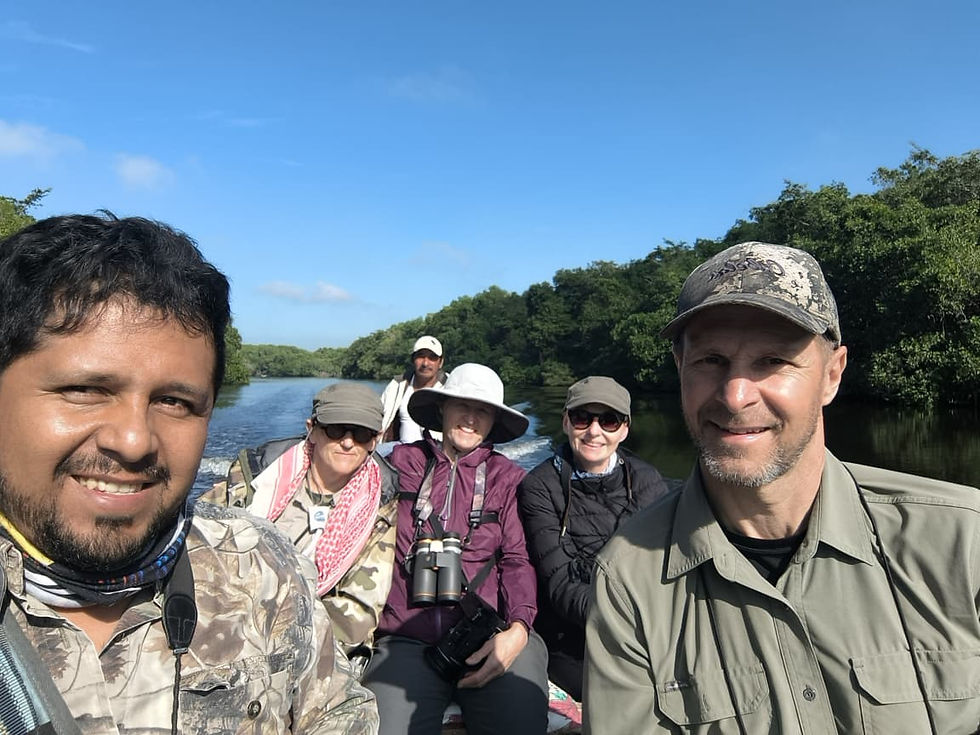
In the Mamantel River, Don Jaime offers a boat tour starting from the section of the river located right behind his home, traveling several kilometers and passing through forest areas, ranches, and houses. For us, establishing communication with local guides is vital. By hiring Don Jaime, you are not only benefiting him directly, but by traveling with a group of people, you also bring a small economic boost to the town, which in this case is Pital Viejo.
This place is incredible; even before boarding the boat, new species like the Rufous-tailed Hummingbird, Orchard Oriole, and Western Tanager made an appearance while we were getting ready. Once on the boat, we observed 44 species, highlighted by the river specialty, the Sungrebe, alongside new additions to our trip list like the Lesser Nighthawk and the Yellow-headed Amazon.

I can confidently say that the Sungrebe is the specialty of this route. Although its range extends from Mexico to South America, finding it is not always easy. It prefers well-preserved freshwater bodies and tends to stay hidden among the shoreline vegetation. If you still have this species on your target list, we highly recommend visiting this site, as it has been one of the most reliable birds in the area for us, with a 100% success rate on our visits.
We hit the road toward the Calakmul area, making a stop at Laguna Silvituc, that is a beautiful lagoon, perfect for stretching our legs before continuing toward the bat volcano. At this lagoon, we observed common freshwater birds such as the Snail Kite and the Ruddy Crake. Our goal was to arrive at the bat volcano in time to watch the spectacle, so we didn't stay there for long.

Without a doubt, a visit to the bat volcano is a must when you are in this area, even if the main objective of the trip is birdwatching. This spot, located close to where we were staying for this and the following nights, is the exit of a series of underground caves that extend for several meters below ground level. At dusk, thousands of bats from various local species emerge all at once, offering a nature spectacle that everyone should experience at least once in a lifetime. The birders in our group thoroughly enjoyed the experience. Furthermore, the bat activity also attracts some raptors; in this case, we spotted a Collared Forest-Falcon, among others.
We spent that night and the following two nights at Chicanná Ecovillage Resort, which features a series of bungalows surrounded by nature. It is located near the entrance to Calakmul, an area of dense and beautifully preserved forest.
Day 8: January 15
From the moment we gathered to head out very early in the morning, you could feel the group's excitement. Anticipation was high, and for good reason: we were about to enter the tallest and densest forest area in the Yucatan Peninsula. We were eagerly looking forward to seeing the birds. On top of that, this is one of the most imposing archaeological zones of the Maya culture, featuring a massive pyramid that rises high above the forest canopy. All of these factors filled our group of travelers with immense excitement.
That day we were joined by Claudio, a local guide who added a lot to the experience due to his knowledge of both birds and archaeology. The road to the Calakmul archaeological zone from the entrance of the nature reserve is 60 kilometers long. We started very early, making various stops along the way where we found several birds, highlighting some new species for our list such as the Lineated Woodpecker, Tropical Royal Flycatcher, Great Crested Flycatcher, and White-crowned Parrots.

Along this road, it is common to see the Ocellated Turkey in groups of males, females, and juveniles crossing the road or foraging along its edges. One of the most spectacular bird sightings of this morning occurred when we located an Ornate Hawk Eagle nest. In it, we found a pair preparing the nest, and they even copulated while we were watching them. It was an awesome moment.
We did well. By that point, we already had many species on our list and it started to rain a bit. Because of that, we returned to the vehicle and decided to focus on moving ahead to the archaeological zone, where we had lunch before continuing with our birding hike. When the rain stopped, we were eating lunch and managed to spot the Squirrel Cuckoo and Ocellated Turkey right from the parking lot. We were highly entertained watching the birds being so active in the parking lot while we ate our lunch.

Inside the archaeological zone, we located the Wedge-tailed Sabrewing, a Mottled Owl on its daytime roost, Keel-billed Toucan, and the Pale-billed Woodpecker. We also got excellent views of the Northern-barred Woodcreeper, Pale-billed Woodpecker, Yellow-breasted Chat, Montezuma Oropendola, Gray-throated Chat, Blue Bunting, and a very beautiful green female Painted Bunting.
Regarding the latter, once Teresa learned how beautiful the male Painted Bunting is, she made it her personal goal to find one. She had no luck that day. As part of the tour, the birders climbed the main pyramid of Calakmul, from where you can observe the Maya jungle stretching out all around you, with no apparent border.

Upon leaving, our local guide had a roosting spot located for the Middle American Screech-Owl, our star nocturnal bird of this trip. It was very exciting because we let the birders find it on their own. When they succeeded, they were in for a wonderful surprise.
The excitement did not end there; upon returning to our hotel at night, we discovered a Northern Potoo perched right outside our rooms.
Without a doubt, for both them and us, it was a day filled with unforgettable emotions.
Day 9: January 16
Within the Calakmul Biosphere Reserve, there are several archaeological zones, villages, and conservation areas distributed throughout the entire reserve. It is because of this and the wide variety of birds in this region that we decided to spend three nights at the same lodging.
Dos Naciones is a small village located a bit far from our hotel. Because of this, two of our travelers decided to stay behind and rest at the resort. They did not have a bad time at all; they stayed to birdwatch around the resort gardens on their own and relax to recharge their batteries for the next day.

In Dos Naciones, you can find several rural roads surrounded by tall and mixed vegetation. It was well worth going all the way to this spot because we managed to add several species to our list that were unique to our trip, meaning we did not see them anywhere else. These included the Rufous-tailed Jacamar, Mayan Antthrush, Northern Plain-xenops, White-collared Manakin, Black-crowned Tityra, Northern Schiffornis, Ruddy-tailed Flycatcher, and Ochre-bellied Flycatcher, among other birds; all of them unique to this region of the country.
We returned to our hotel where we ate, rested, and birded around the Ecovillage gardens. We wrapped up early since we would be leaving for our next tour destination the following day.
Day 10: January 17
We dedicated this day to traveling toward the state of Quintana Roo. Along the way, we made several key stops that gave us new birds for our trip list and, of course, new experiences that enriched the journey.
The first stop, Kohunlich, is an archaeological zone located between the Calakmul area and the Bacalar lagoon. We started on the road leading to the site while we waited for opening hours. Along this road, we added some new birds to our trip list, such as the Smoky-brown Woodpecker, Northern Bentbill, Lesser Greenlet, Yellow-billed Cacique, and Red-legged Honeycreeper.
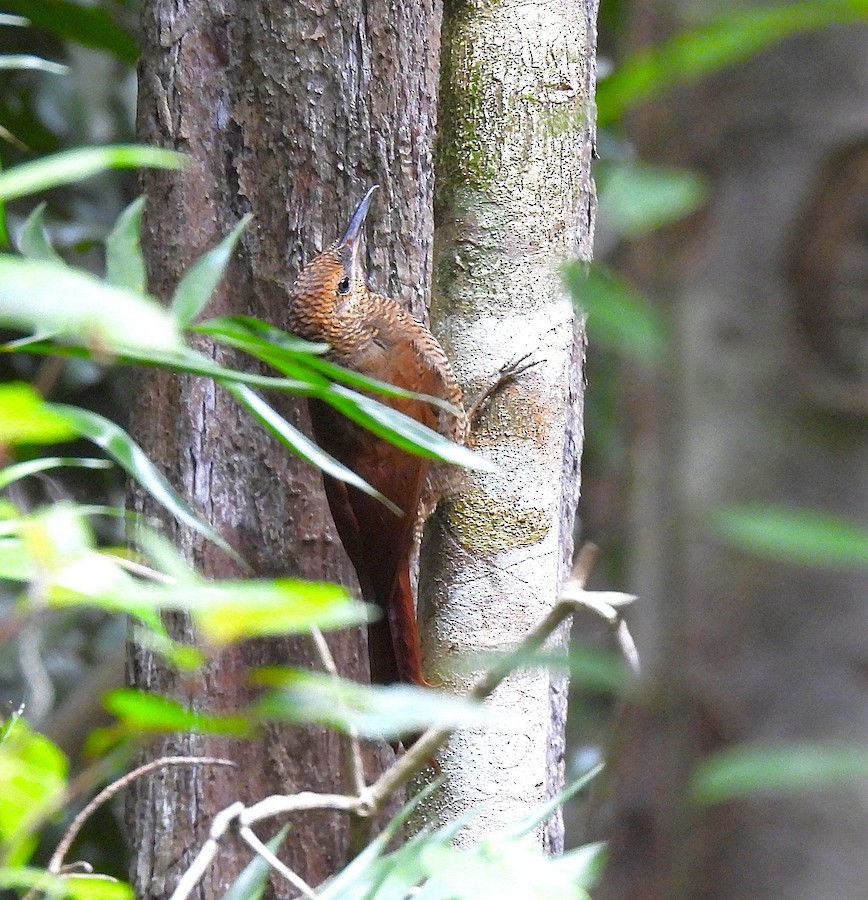
Once inside the archaeological zone, as we walked among the Maya ruins, we had excellent views of birds like the Pale-billed Woodpecker and Red-lored Amazon. Additionally, we found a highly active army ant swarm that was attracting many birds, including the Tawny-winged Woodcreeper, Northern Barred-woodcreeper, and Ivory-billed Woodcreeper. One of the main pyramids in Kohunlich is famous for the impressive masks decorating its covered facade. From there, we spotted several warblers and the Ruddy Woodcreeper.

Afterward, we continued driving to Bacalar, where we ate and recharged our batteries to keep going. As we walked through the main plaza, where the ruins of the fort that used to protect the town against pirates are located, we spotted the Yellow-winged Tanager, a species that is usually found in the plazas of small towns in this area.
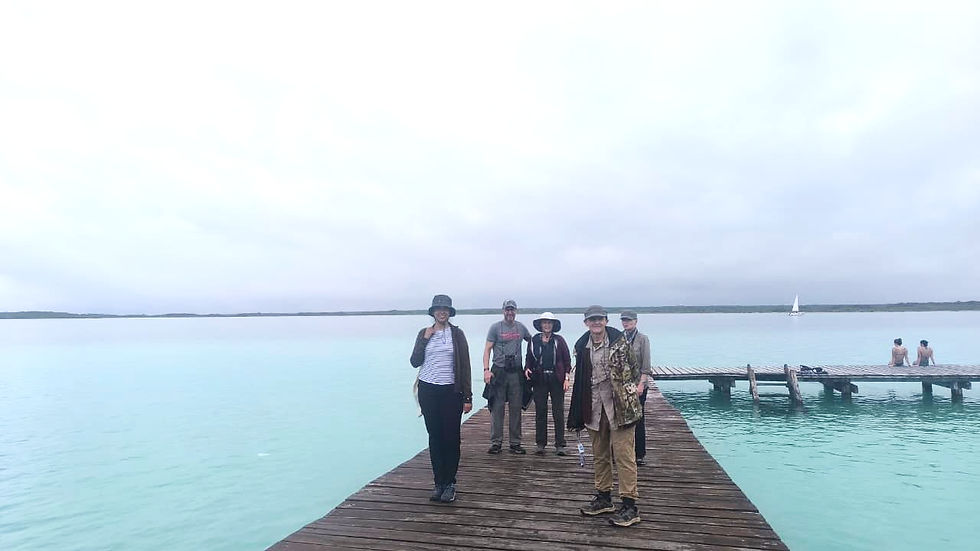
Afterward, we walked along a wooden boardwalk, from where we observed the Limpkin and Green Heron, while a few Mangrove Swallows flew overhead. We also spotted a Lesser Scaup and we were able to appreciate the beautiful landscape of the Lagoon of Seven Colors. This place is an intermediate stop on the way to Playa del Carmen; the Snail Kite can sometimesbe seen here, but we missed it this time.
From there, we continued driving toward the Riviera Maya, making a stop at a site adjacent to the Muyil archaeological zone, where we caught our first glimpse of the Rose-throated Tanager just before dusk.
We stayed in Playa del Carmen, where we had dinner and walked along the famous Quinta Avenida, popular among tourists for its variety of shops, restaurants, and nightlife spots. We then headed back to sleep, as the first ferry to Cozumel Island was waiting for us the next morning.
Day 11: January 18
We got ready to take the first ferry to Cozumel Island. This was officially the last day of birding for our group of birdwatchers, and it was filled with surprises right up to the very last minute.
We bought breakfast at a spot before leaving for the island, and the ferry ride took about 45 minutes. On the other side, the rental van was waiting for us to explore the birding hotspots. We started in a scrubby area just outside the city, in an abandoned parking lot that had been overtaken by bushes, flowering plants, and fruits. This site gifted us most of the island's specialties: the Cozumel Emerald, Cozumel Wren, and Cozumel Vireo, as well as the endemic subspecies of the Blue-gray Gnatcatcher, Rufous-browed Peppershrike, Yellow-faced Grassquit, and Yucatan Woodpecker. We also added other new birds to the trip list, such as the Worm-eating Warbler.
Afterward, we went to El Cedral, an ecotourism site that combines Maya archaeology and nature. At this site, we made an effort to locate the Yucatan Vireo and saw several highly active warblers, as well as great views of the Cozumel Emerald.

We took a break during our route to use the restroom and grab a soda. Without planning or even thinking about it, that was exactly where we got several very pleasant surprises: we finally saw the male Painted Bunting, or as Teresa called it, the "Painted Lady." Teresa shared her joy and tenderness with us upon seeing the bird she had wanted to see so badly, on the very last day of her trip. Also, at that same spot, we saw a Caribbean Elaenia, another one of the final targets of our journey.
Before arriving at our next and final birding hotspot on the island, we went to eat at a place where they serve abundant, fresh, and delicious seafood dishes. We then headed north, near the water treatment plant, where we saw the Ruddy Crake and the island's subspecies of the Mangrove Warbler (which has a distinct rufous cap and is a truly beautiful warbler). We also spotted a Palm Warbler, which was new to our list. At this point, we decided to head back, as two of our companions had to catch a flight back home that same night.
On the ferry ride back, we talked and celebrated our achievements, reminiscing about the great moments and celebrating new friendships. We congratulated one another on our shared efforts and milestones, and exchanged well wishes, since the group would split up from that moment on. As the itinerary states, this trip includes the return transfer to the airport in Cancun. That night, Linda and Teresa were heading back home. On the way to the airport, they shared very valuable feedback regarding our services, and we thanked them for being excellent travel companions. The following day, it would be Randy and Sandy's turn to head home as well.

This group of people met in Mexico. They wished to get to know the birds and experience the diverse cultural and natural options that our Yucatan Peninsula has to offer. Birds became the common ground to develop a friendship, a friendship that prevails to this day, so much so that they even wish to repeat the experience on a future occasion. They know they can count on us to organize and prepare their next expedition through Mexico.
Day 12: January 19
Day 12, in this case, consisted of dropping our birdwatchers off at the airport. On other occasions, depending on the flight schedule, we can take advantage of the morning for one last birding session, have breakfast, and still be at the airport on time.
If you read all the way to the end, were you able to figure out which day was our birdwatching group's favorite? Did you think it was the day we managed to see hundreds of birds on a remote beach in Rio Lagartos, or when we traveled along the Mamantel River to get an up-close look at the Sungrebe, or perhaps when they witnessed the spectacle at the bat volcano? In the end, on the last evening the group was complete, chatting and laughing, they mentioned that their favorite day was Day 8.
Do you agree with them? It was the day that had it all: incredible birds, surprises, culture, learning, and a good dose of excitement.
What makes an excellent day of birding for you? Perhaps the words in this text weren't enough to describe just how exciting that day was, but for our travelers, it undoubtedly was.
We are deeply grateful for the trust our birdwatchers placed in us to travel together:
Joan, Dave, Andy, Sandy, Teresa, and Linda.
Without a doubt, they are incredible people.
Thanks to them, we enjoyed this trip immensely, too.
Photo credits for this document: Randy Arsenault y Joel Ortega
. . .
Join us on our next 12-day birding expedition in Yucatan on January 7th 2027:
If you want more information, please send us an email to: info@birdingmx.com

Comments